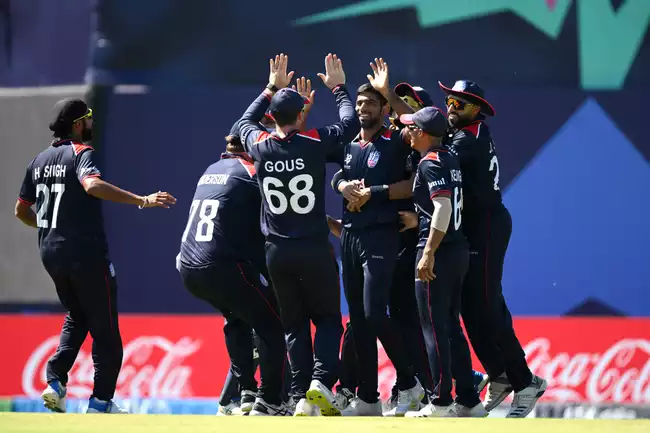
One of the defining moments of the USA’s historic T20 World Cup 2024 victory over Pakistan came in the very first six overs of Pakistan’s innings. USA’s pace bowlers produced an extraordinary powerplay performance, reducing one of the world’s most feared batting lineups to 30 for 3 — exposing a fragility that would haunt Pakistan for the rest of the tournament.
How USA Dismantled Pakistan’s Batting in the Powerplay
In T20 cricket, the six-over powerplay is often decided by the batting side. Fielding restrictions allow batters to attack freely, and teams like Pakistan — with a deep line-up of technically gifted top-order players — are expected to capitalise. On this occasion, USA turned that logic completely on its head.
Pakistan’s top three — Mohammad Rizwan, Babar Azam, and Usman Khan — were all dismissed cheaply within the powerplay, leaving the innings in serious trouble at 30 for 3. For a detailed look at how Babar Azam attempted to rebuild, see our player analysis: Babar Azam’s slow start and recovery partnership with Shadab Khan.
The USA Bowling Attack: A Closer Look
The USA’s pace bowling unit during the powerplay was a revelation. Saurabh Netravalkar, Ali Khan, and Jasdeep Singh formed a formidable seam attack that generated genuine pace, swing, and awkward bounce from the drop-in pitch at Grand Prairie Stadium.
Saurabh Netravalkar: The Left-Arm Menace
Netravalkar’s left-arm angle proved particularly problematic for Pakistan’s right-handed top order. Moving the ball both ways from around the wicket, he created consistent pressure and was rewarded with early wickets. His ability to hit the top of off stump repeatedly was reminiscent of quality international seam bowling at the highest level.
Ali Khan and Jasdeep Singh: Support Fire
Ali Khan, born in Pakistan himself before qualifying for the USA, and Jasdeep Singh complemented Netravalkar superbly. Both bowlers maintained excellent lines and lengths, denying Pakistan’s batters the width they needed to free their arms. The powerplay economy rate USA achieved was exceptional given the quality of opposition they were facing.
Why Pakistan’s Powerplay Collapse Was So Surprising
Pakistan are widely regarded as one of the most technically accomplished sides in world cricket. Their top order — led by Babar Azam, consistently ranked among the top T20 batters on the planet — was expected to set a commanding platform. The collapse to 30 for 3 was therefore seismic, not just in the context of this match but in the broader story of associate cricket asserting itself against the established powers.
It also exposed the psychological challenge facing Pakistan in this unusual setting. Competing in a purpose-built stadium in Texas, in front of a genuinely partisan American crowd, on an unfamiliar drop-in pitch — the conditions were simply not what Pakistan’s top-order batters were accustomed to.
What the Powerplay Collapse Meant for the Rest of the Match
The early wickets put enormous pressure on Pakistan’s middle order to consolidate rather than accelerate. This ultimately led to a lower first-innings total than Pakistan’s quality deserved, which in turn gave the USA a genuinely winnable target. The chain of events that followed — Aaron Jones’s extraordinary innings, the tie, and the Super Over — all trace back to these six devastating powerplay overs.
For the full match story, read our complete report on how USA beat Pakistan in a Super Over at the T20 World Cup 2024.
Tactical Lessons: What Pakistan Should Have Done Differently
In hindsight, Pakistan’s approach in the powerplay came under significant criticism. Playing their natural aggressive game against a seam attack operating at full tilt in helpful conditions was a risky strategy. Several analysts suggested that a more conservative approach in the first three overs — allowing eyes to adjust to the pitch — would have been more pragmatic given the circumstances.
Pakistan’s batting coach and captain Babar Azam acknowledged post-match that the team had underestimated USA’s bowling quality. It was a lesson that resonated throughout the 2024 World Cup and prompted widespread debate about whether associate nations had genuinely closed the gap on the traditional cricketing powers.
Frequently Asked Questions
What was Pakistan’s score after the powerplay vs USA at T20 World Cup 2024?
Pakistan were reduced to 30 for 3 at the end of the six-over powerplay during their T20 World Cup 2024 group match against the USA at Grand Prairie Stadium, Dallas.
Who bowled in the powerplay for USA against Pakistan?
USA’s powerplay bowling was primarily handled by Saurabh Netravalkar (left-arm seam), Ali Khan, and Jasdeep Singh. Netravalkar in particular was outstanding, generating swing and generating early wickets with his left-arm angle.
Why did Pakistan collapse in the powerplay against USA?
A combination of excellent USA bowling, an unfamiliar drop-in pitch at Grand Prairie Stadium, and the psychological challenge of an unusual environment contributed to Pakistan’s powerplay collapse. USA’s bowlers were sharper and more disciplined than most expected, and Pakistan’s batters were not able to adjust quickly enough.
For the latest cricket analysis and match reports, visit World Sports News Latest News.